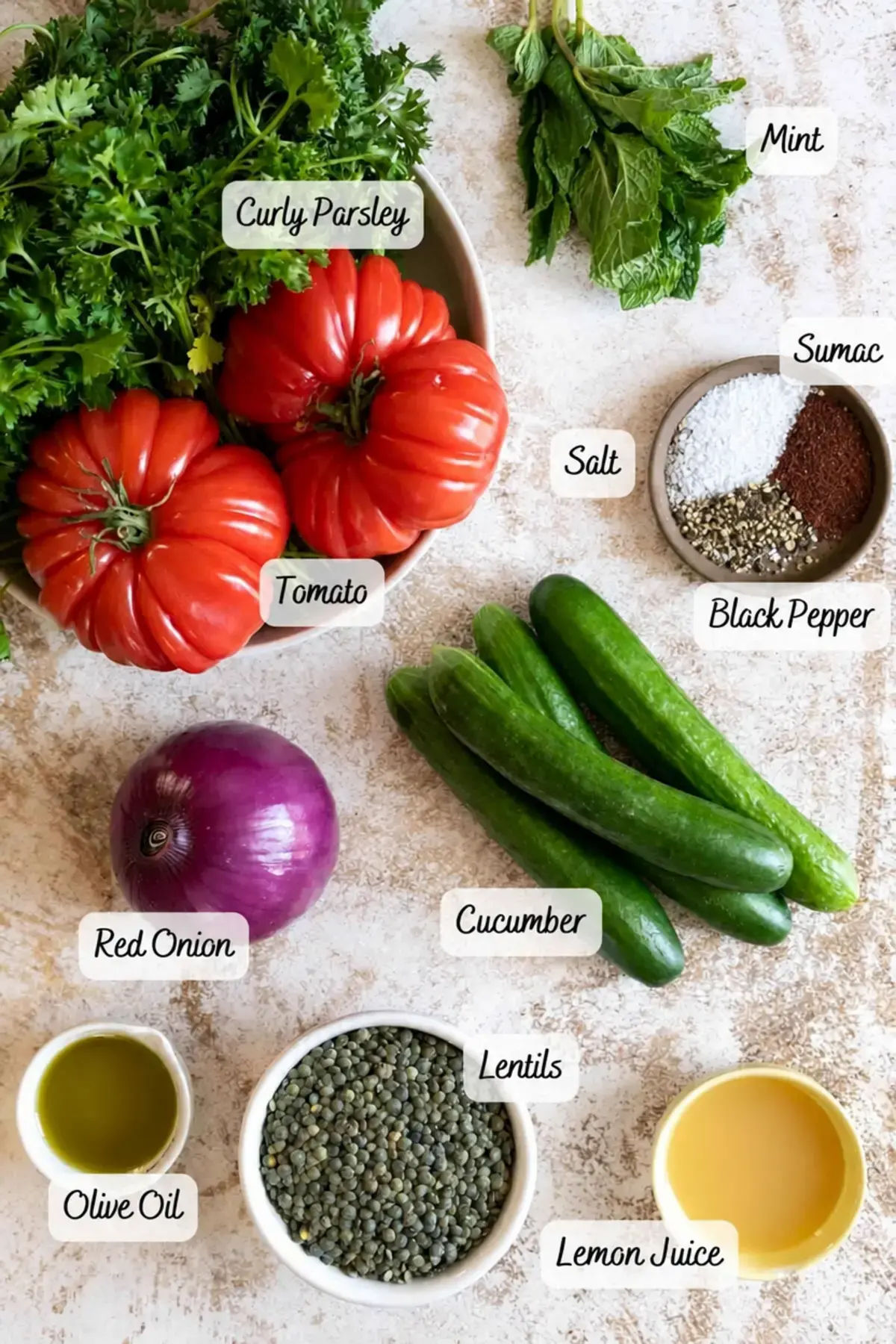
This lentil tabbouleh is the bowl I bring when the herbs in my garden are finally tall and the tomatoes actually taste like tomatoes.
It is a gluten free take on tabbouleh, the traditional Middle Eastern salad, and it swaps the usual bulgur wheat for freshly cooked lentils while keeping the same seasonings.
The salad stays bright and herb forward, and it travels well to a potluck or a picnic.
Traditional tabbouleh, sometimes spelled tabouli, is built on a mountain of chopped parsley along with tomatoes, onions, and mint, mixed with bulgur or cracked wheat. What makes it unusual among salads is what it leaves out. There is no lettuce, and parsley is the star of the bowl rather than a garnish scattered on top.
Bulgur can be hard to find in some grocery stores, and it is not gluten free, so lentils step in and do the same work.
Lentil Tabbouleh Recipe: A Fresh And Healthy Gluten-Free Salad 21
Their small, firm shape gives the salad body, and they soak up lemon juice and olive oil in a way that grains do not. Every bite still tastes like tabbouleh, just with a little more substance.
I serve it as a summer side dish, and I also eat it as a quick lunch, sometimes with a little shredded rotisserie chicken stirred in. On a mezze table it sits happily beside hummus, olives, and warm flatbread.
If you are building a whole plate around it, it pairs well with harissa roasted cauliflower, turkey burgers, BBQ chicken thighs, or homemade smoked ribs.
Here is the recipe at a glance:
Detail
Amount
Servings
6
Prep time
10 minutes
Cook time
0 minutes
Total time
10 minutes
Style
No cook assembly with already cooked lentils
One thing I love about this recipe is how it improves as it sits. The lemon and the oil keep working on the lentils and the chopped herbs, so a bowl mixed in the morning tastes even better by dinner. That makes it a genuinely useful make ahead dish for gatherings.
I very much feel it is necessary to say this out loud: sumac belongs in tabbouleh. Plenty of recipes list it as optional. I do not treat it that way.
Its tart, fruity character adds an almost acidic brightness without adding more liquid, so the salad never turns watery the way it can when you keep pouring in extra lemon juice or vinegar to chase that missing tang.
Lentil Tabbouleh Recipe: A Fresh And Healthy Gluten-Free Salad 22
If you cannot find sumac, you are not stuck. Use ½ teaspoon of lemon zest, or a splash of red or white wine vinegar. Another good option is Za’atar, a Middle Eastern spice mix that already contains sumac along with sesame and herbs, so it brings the tart note plus a little extra savory depth.
Half a teaspoon is enough for six servings. Start there, taste, and add a pinch more if you want the salad to lean tarter. A little goes a long way, and too much can taste dusty rather than bright.
Ingredient Notes
Good tabbouleh is really about the shopping, so here is how I choose each component and what I swap when I have to.
Parsley: Traditional tabbouleh uses curly parsley because it gives the salad a fluffier texture. Flat leaf, also called Italian parsley, works fine if that is what your store carries. You need 2 bunches.
Lentils: Puy lentils, the small green ones, are my pick because their size and shape match the chopped vegetables. The recipe calls for 1 cup of cooked lentils, and quinoa is a good alternative if you want a different texture. If you cook from scratch, start with ½ cup of uncooked French green or black lentils.
Cucumber: Use ½ English cucumber, or 2 small Persian cucumbers. Both have thin skins, so I leave the skin on for color and crunch. If your cucumber has a thick skin, peel it first.
Tomatoes: Reach for a ripe, firm, larger tomato such as beefsteak, heirloom, or on the vine. You need ½ cup diced. Softer tomatoes release too much water and make the salad soggy.
Red onion: Sweet red onion is what I prefer, finely diced, about ⅓ cup. Sweet white onion such as Vidalia, or finely sliced spring onions, are both fine substitutes when raw red onion tastes too sharp.
Mint: 10 fresh mint leaves lift the whole bowl. If you do not care for mint, fresh dill is a lovely replacement.
Olive oil: Extra virgin olive oil is not strictly necessary, but it gives a noticeably stronger flavor. I use ¼ cup and I use the good bottle here.
Lemon juice: You need ⅓ cup of fresh juice, which takes 2 to 3 large, juicy lemons. Bottled juice will work in a pinch, but the fresh kind tastes brighter.
Seasonings: 1 teaspoon kosher salt, ½ teaspoon freshly ground black pepper, and ½ teaspoon sumac. The sumac is listed as optional in most versions, and I explained above why I never skip it.
If you keep these nine things in mind, the salad will taste balanced rather than sharp or watery, and that is most of the battle with tabbouleh.
️How to Make Lentil Salad
The assembly is quick, but a few small habits make a real difference in the finished bowl.
Lentil Tabbouleh Recipe: A Fresh And Healthy Gluten-Free Salad 23Lentil Tabbouleh Recipe: A Fresh And Healthy Gluten-Free Salad 24
If you are cooking lentils from scratch, spread them on a plate first and pick through for any stray bits of debris or small stones.
Add the lentils and 1 bay leaf to a small pot and cover them with cold water. Vegetable stock works instead of water if you want a little more flavor.
Bring to a boil, then cover, reduce the heat, and simmer for 15 to 18 minutes, until the lentils are tender but not mushy. Drain and let them cool.
Short on time? Precooked lentils from the store are a fine shortcut. The recipe times assume you are starting with lentils that are already cooked and cooled.
Once the lentils are cool, combine them with the lemon juice and the olive oil and set the bowl aside. Give them a few minutes to absorb the dressing. This is the step that makes lentil tabbouleh taste seasoned all the way through instead of just on the surface.
Wash the vegetables and herbs, then dry them thoroughly. Excess water is the enemy of tabbouleh.
Dice the cucumber, tomato, and onion into small, uniform pieces and finely chop the herbs. Do all of this by hand. A food processor turns everything to paste, and tabbouleh depends on small, distinct pieces of vegetables and herbs, not a puree.
Combine the herbs, cucumber, tomato, and onion in a mixing bowl, then stir in the dressed lentils.
Season to taste with the sumac, salt, and pepper right before serving.
Dry your herbs and vegetables well after washing. Water clinging to the parsley is the most common reason a beautiful bowl of tabbouleh turns soupy by the next day.
Lentil Tabbouleh Recipe: A Fresh And Healthy Gluten-Free Salad 25Lentil Tabbouleh Recipe: A Fresh And Healthy Gluten-Free Salad 26
That is the whole method. From a bowl of cooked lentils to a finished salad, it takes about ten minutes of hands on work.
What to Serve with Tabbouleh
Tabbouleh is flexible. I eat it straight from the bowl with a fork, and I also treat it as a dip, scooping it up with gluten free flatbread or pita. It spreads nicely over other foods too, so it works as a fresh layer on a grain bowl or over a piece of grilled fish.
For lunches, my favorite trick is to top it with shredded rotisserie chicken. It turns a side salad into a full meal in about thirty seconds, which is exactly what I want on a busy weekday.
It also belongs on a mezze platter with hummus, olives, stuffed grape leaves, and warm bread. As part of a larger meal, it holds its own next to roasted vegetables like eggplant or portobello mushroom caps, Greek roasted potatoes with feta, and saffron rice.
If you are planning a cookout menu, it sits comfortably alongside harissa roasted cauliflower, turkey burgers, BBQ chicken thighs, or homemade smoked ribs. The cool, tart herbs balance smoky grilled food especially well, which is why I keep a bowl of it in the fridge all summer.
Common Recipe Questions
Why is my tabbouleh bitter?
Bitter tabbouleh usually comes down to the parsley. If it is not chopped finely enough, or if the bowl simply has too much parsley relative to everything else, the salad tastes sharp and green in a way that is not pleasant. The fix is easy.
Add extra mint, a little more salt, another pinch of sumac, or some lemon zest to balance it out.
Can I make tabbouleh ahead of time?
Yes, and I often do. It can be made up to a day in advance, and the flavors marry beautifully as it sits. Keep it covered in the refrigerator until you are ready to serve it.
How do I store leftovers?
Store lentil tabbouleh in an airtight container in the refrigerator for up to 4 days. Do not freeze it. The herbs and cucumber lose their texture once thawed, and the salad will not be worth eating.
What can I substitute for red onion?
Thinly sliced green onions, about 4 of them, work well in place of the red onion. So does a sweet white onion such as Vidalia if you want something milder but still crisp.
What can I substitute for mint?
Fresh dill is the closest match. Use a similar small handful, taste as you go, and adjust the salt at the end.
FAQs
What lentils are best for lentil tabbouleh?
French green lentils, also called Puy lentils, are the best choice because they hold their shape and have a slightly peppery flavor. Black lentils and brown lentils also work well. Avoid red or yellow lentils, as they become mushy when cooked.
Why is my tabbouleh bitter?
Bitterness in tabbouleh is often caused by parsley that is not chopped finely enough or by using too much parsley. To fix it, add extra mint, a pinch of sumac, lemon zest, or a little extra salt to balance the flavors.
Can you make lentil tabbouleh ahead of time?
Yes, lentil tabbouleh can be made up to a day in advance. Preparing it ahead allows the flavors to meld and results in a beautifully marinated salad. Store it in an airtight container in the refrigerator for up to four days.
What is sumac and is it necessary for tabbouleh?
Sumac is a tangy, lemony spice made from dried and ground sumac berries. While it is highly recommended for its bright acidity without adding liquid, it is optional. If you do not have sumac, substitute half a teaspoon of lemon zest or a splash of wine vinegar.
Tabbouleh Recipe with Lentils (Gluten Free) This lentil tabbouleh is the bowl I bring when the herbs in my garden are finally tall and the tomatoes actually taste like tomatoes. It is a gluten free take on tabbouleh, the traditional Middle Eastern salad, and it swaps the usual bulgur wheat for freshly cooked lentils while keeping the same seasonings.
Total Time:10 min
Yield:61x
Ingredients
Scale
Main Ingredients 1 cup cooked lentils ⅓ cup fresh lemon juice ¼ cup extra-virgin olive oil 2 bunches curly parsley 10 mint leaves ½ English cucumber, diced ½ cup tomatoes, diced ⅓ cup red onion, finely diced 1 teaspoon kosher salt ½ teaspoon freshly ground black pepper ½ teaspoon sumac
Cooked Lentils (optional scratch preparation) ½ cup uncooked French green or black lentils 1 bay leaf water
Instructions
Main Instructions 1-Combine the lentils, lemon juice, and olive: Combine the lentils, lemon juice, and olive oil. Set aside. 2-Finely chop the herbs: Finely chop the herbs. Combine the herbs, cucumber, tomato, and onion in a mixing bowl. Stir in the lentils. 3-Season to taste with the sumac, salt: Season to taste with the sumac, salt and pepper right before serving.
Cooked Lentils (optional) 4-In a medium saucepan, combine the lentils,: In a medium saucepan, combine the lentils, bay leaf, and water and bring to a boil. Cover, reduce the heat, and simmer, stirring occasionally, for 15 to 18 minutes or until tender but not mushy. Drain and let cool.
Last Step:
Please leave a rating and comment letting us know how you liked this recipe! This helps our business to thrive and continue providing free, high-quality recipes for you.