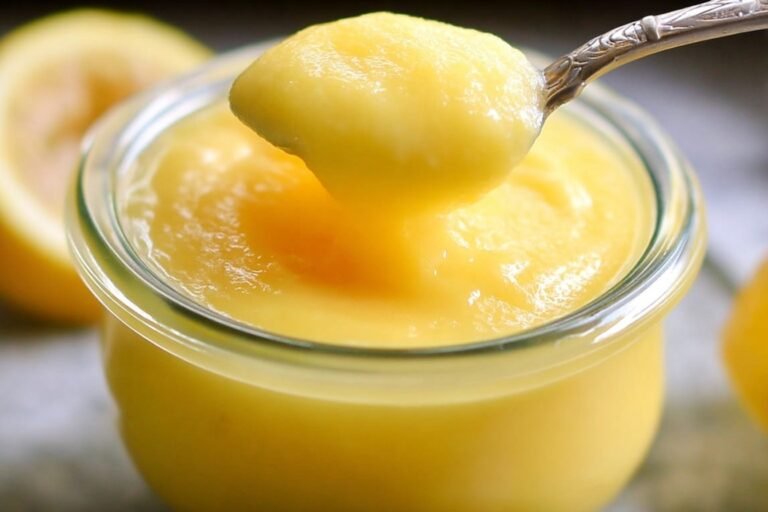
Ingredients
– 1 cup sugar for sweetening the curd and balancing the tart lemon juice
– Finely grated zest from 2 lemons for adding fresh lemon oil and giving the curd its bold citrus aroma
– 1/2 cup lemon juice for supplying the tangy flavor that makes lemon curd shine
– 2 egg yolks for adding richness and helping create a smooth, custard-like texture
– 3 large eggs for giving the curd body and helping it thicken as it cooks
– 4 ounces salted butter, 1 stick, cut into cubes for making the curd creamy and glossy
– 1/8 teaspoon salt for sharpening the flavor and keeping the curd balanced
Instructions
1-First Step: Gather and prep your ingredients Start by measuring out 1 cup sugar, 1/2 cup lemon juice, 2 egg yolks, 3 large eggs, 4 ounces salted butter cut into cubes, and the finely grated zest from 2 lemons. If your butter is unsalted, also measure 1/8 teaspoon salt. Use a large microwave-safe bowl with enough room for whisking, because the mixture needs to be stirred well between microwave bursts. If you want the smoothest result, let your eggs sit at room temperature for a little while before mixing. This helps them blend more easily and lowers the chance of uneven cooking. A good whisk and a fine-mesh strainer are also handy tools to keep close by.
2-Second Step: Whisk the base until smooth Add the sugar, eggs, egg yolks, lemon juice, and salt if needed into the bowl. Whisk everything together until the mixture looks smooth and even. You do not need to beat in a lot of air, but the goal is to fully combine the ingredients so the sugar starts dissolving and the eggs are well distributed. At this stage, the mixture may look a little thin. That is exactly what you want. The thickening happens in the microwave, so do not worry if it does not look like curd yet.
3-Third Step: Add the butter cubes Drop in the butter cubes and give the bowl one more quick whisk. The butter will begin to melt as the curd heats. Cutting the butter into cubes helps it melt faster and more evenly, which is especially useful when you are working with short microwave intervals. Salted butter gives the curd a balanced taste, but if you only have unsalted butter, the small pinch of salt keeps the flavor from tasting one-note. That tiny bit makes the lemon pop a little more.
4-Fourth Step: Microwave in short bursts Microwave the mixture on high for 45 seconds. Then stop and whisk vigorously. This first stir is important because it helps distribute the heat and keeps the eggs from cooking too quickly in one spot. Microwave power varies a lot, so a strong whisk between bursts makes a big difference. Continue microwaving in 45-second intervals, whisking after each round, for about 4 to 7 minutes total. Most microwaves will land closer to 5 to 7 minutes, but the exact time depends on wattage and how cold the ingredients were at the start. The curd may look loose at first, then suddenly begin to thicken as it nears the finish line. Whisking between microwave bursts is the secret to a smooth curd. It helps prevent scrambled egg bits and gives you a glossy finish.
5-Fifth Step: Check for doneness The curd is ready when it coats the back of a metal spoon or reaches 175°F. If you use a thermometer, that temperature gives you a very reliable cue. The curd should look thicker, creamy, and lightly glossy. It will still seem a little softer than the final texture you want, because it continues to firm up as it cools. If you are unsure, it is better to stop once the curd coats the spoon rather than overcook it. Overheating can make the eggs curdle, and the texture may turn grainy. If that happens, a quick strain can save the batch.
6-Sixth Step: Finish with lemon zest and strain if needed Take the bowl out of the microwave and whisk it well. Then stir in the finely grated lemon zest. Adding the zest at the end keeps its flavor fresh and bright. If you notice any tiny lumps, pass the curd through a fine-mesh strainer for a silky smooth finish. This step is worth the extra minute if you want a polished result. It gives the curd that luscious texture you expect from bakery-style lemon filling.
7-Seventh Step: Cool, store, and serve Let the curd cool to room temperature. As it cools, it will thicken more, so do not worry if it still seems a bit loose right after cooking. Once cooled, cover it and store it in the refrigerator. After chilling, it becomes beautifully spreadable and ready for toast, filling, or topping. If you are making a dessert spread for a brunch table, this is the moment to plan your serving ideas. Microwave Lemon Curd is wonderful on pancakes, waffles, crepes, and scones, or spooned over fresh fruit. It also plays nicely with fluffy desserts like strawberry mousse when you want a sweet and tangy contrast.
Last Step:
Please leave a rating and comment letting us know how you liked this recipe! This helps our business to thrive and continue providing free, high-quality recipes for you.Notes
🍋 Zest only the yellow peel with a rasp or zester to avoid bitter white pith.
🕳️ Strain through a fine-mesh sieve if lumps appear for ultra-smooth curd.
❄️ Refrigerate up to 10 days or freeze up to 1 year in airtight containers.
- Prep Time: 5 minutes
- Cooling: Room temperature
- Cook Time: 6 minutes
- Category: Dessert
- Method: Microwave
- Cuisine: American
- Diet: Vegetarian, Gluten-Free
Nutrition
- Serving Size: 1 tablespoon
- Calories: 60 calories
- Sugar: 6g
- Sodium: 30mg
- Fat: 4g
- Saturated Fat: 2g
- Unsaturated Fat: 2g
- Trans Fat: 0g
- Carbohydrates: 7g
- Fiber: 0g
- Protein: 1g
- Cholesterol: 36mg